

- 13726
- 817
- 20
- 24
- 0
- Help Ukraine
About the solution
They founded (these)abilities, a design & technology startup that aims to "Disable Disabilities" by designing & building products that level the playing field for Persons with Disabilities (PwDs) at work, at home and during play.
A keyguard is a plastic or metal plate placed on top of a keyboard, with holes aligned to the keyboard's keys.
It makes the keys recessed, making it easier for people with upper-limb mobility issues - such as those who have suffered strokes or have Parkinson's disease or muscular dystrophy - to use a keyboard.
They changed the manufacturing process by using a new technology in which the scanned image of a keyboard layout can be sent to a laser cutting facility to cut the plastic according to the layout. This means keyguards can be customised to any keyboard, and costs are halved.
"I felt it was social injustice. People are born differently abled, not disabled, but because society has minimal inclusion for such people, it renders them disabled. I found it to be a design problem," he said.
(these)abilities was recently selected for a programme which helps start-ups that tackle challenges faced by people with disabilities, and it received seed funding of $10,000 from Singtel earlier this year. Singtel's vice-president of group corporate social responsibility Andrew Buay said: "Their business model focused on simple and cost-effective accessibility solutions for persons with disabilities."
Adapted from: http://bit.ly/1Y0D7gs
More info: http://www.theseabilities.com/
What about you, do you have any solutions? Please share them with the Patient Innovation community!
这些解决方案不应包括使用药物,化学品或生物制品(包括食品);创伤性设备;冒犯性的,商业或内在危险的内容。该解决方案未经医学验证。请谨慎进行!如果您有任何疑问,请咨询健康专家。
DISCLAIMER: This story was written by someone who is not the author of the solution, therefore please be advised that, although it was written with the utmost respect for the innovation and the innovator, there can be some incorrect statements. If you find any errors please contact the patient Innovation team via info@patient-innovation.com
-
-
485
-
0
-
4192
Collaborator James Leckey makes equipment to improve the quality of life and social inclusion of children with special needs
MOVING IN A WHEELCHAIR: Moving using a wheelchair.
BODY BALANCE: Maintaining body balance
STANDING UP: Standing up from a seated position
Playing
Neuromuscular Disorders
Assistive Daily Life Device (to help ADL)
Walking Aid (wheelchair/walker/crutches)
Assistive Technology access
5 Senses support devices: (glasses, hearing aids, headphones...)
Restoring mobility
Promoting self-management
Managing Neurological Disorders
Promoting inclusivity and social integration
Maintaining Balance and Mobility
Raise awareness
General and Family Medicine
Neurology
Orthopedics
Pediatrics
Physical Medicine and Rehabilitation
United States
-
-
-
640
-
0
-
8952
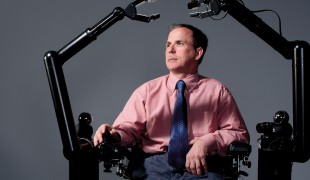
Paralyzed man designs innovative wheelchairs
CAREGIVING
MOVING IN A WHEELCHAIR: Moving using a wheelchair.
Grip
Rubgy
Basketball
Paralysis
Cervical spinal cord injury/Tetraplegia
Assistive Daily Life Device (to help ADL)
Assistive Technology access
Walking Aid (wheelchair/walker/crutches)
Restoring mobility
Replacing lost limbs
Promoting self-management
Promoting inclusivity and social integration
Recovering from Traumatic Injuries
Preventing (Vaccination, Protection, Falls, Research/Mapping)
Caregiving Support
Neurology
Orthopedics
Physical Medicine and Rehabilitation
United States
-
-
-
580
-
0
-
6661

Dad combines devices to help disabled child use computers
COMMUNICATION: Communicating, whether by speaking, listening, or other means
Playing
Cerebral Palsy
Assistive Technology access
AI algorithm
Restoring mobility
Promoting self-management
Managing Neurological Disorders
Promoting inclusivity and social integration
Improving Speech and Communication
Preventing (Vaccination, Protection, Falls, Research/Mapping)
Raise awareness
Child and Adolescent Psychiatry
General and Family Medicine
Neurology
Pediatrics
Canada
-
 zh
zh