

- 7619
- 603
- 14
- 14
- 2
- Help Ukraine
About the solution
Hen Yin Qi was driven to invent this solution because her aunt suffers from Parkinson’s disease and struggles with simple tasks.
"I could see her struggling with drinking water or writing because her hands were shaking", the inventor explained.
The innovation - called Shaky - is a device that can be attached to objects such as utensils, plates and cups to monitor tremors, aimed at helping to manage Parkinson's disease and perform simple daily tasks like drinking. It can also counter the tremors and stabilise the objects.
The team entered the 2018 Samsung Solve for Tomorrow competition and Shaky got among the 10 shortlisted submissions.
The two students plan to further develop the gadget so it can also serve as a solution to turbulence on an airplane.
Adapted from: https://bit.ly/2AYfUEH
这些解决方案不应包括使用药物,化学品或生物制品(包括食品);创伤性设备;冒犯性的,商业或内在危险的内容。该解决方案未经医学验证。请谨慎进行!如果您有任何疑问,请咨询健康专家。
DISCLAIMER: This story was written by someone who is not the author of the solution, therefore please be advised that, although it was written with the utmost respect for the innovation and the innovator, there can be some incorrect statements. If you find any errors please contact the patient Innovation team via info@patient-innovation.com
-
-
483
-
0
-
5292

A wheelchair-mountable assistive device to support users with reduced upper limb muscle strength
(SELF)-CARE: EATING: Eating independently.
(SELF)-CARE: DRINKING: Drinking independently.
MOVING IN A WHEELCHAIR: Moving using a wheelchair.
Muscular Dystrophy
Neuromuscular Disorders
Muscle Tone Abnormalities weakness
Amyotrophic Lateral Sclerosis
Cerebral Palsy
Spinal Cord and Nerve Root Disorders
Assistive Daily Life Device (to help ADL)
Muscle cramps or spasms
Difficulty coordinating movements
Stiffness or rigidity (difficulty moving)
Paralysis of the legs and lower body
Muscle weakness
Promoting self-management
Managing Neurological Disorders
Medical Genetics
Neurology
Switzerland
-
-
-
704
-
0
-
9004
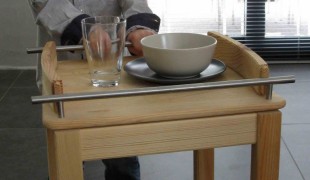
Father creates stabilizer for his son
CAREGIVING
(SELF)-CARE: EATING: Eating independently.
(SELF)-CARE: DRINKING: Drinking independently.
Playing
Spinal Cord and Nerve Root Disorders
Cerebral Palsy
Neuromuscular Disorders
Assistive Daily Life Device (to help ADL)
Muscle cramps or spasms
Difficulty coordinating movements
Stiffness or rigidity (difficulty moving)
Paralysis of the legs and lower body
Muscle weakness
Managing Neurological Disorders
Preventing (Vaccination, Protection, Falls, Research/Mapping)
Caregiving Support
Neurology
Pediatrics
Belgium
-
-
-
891
-
0
-
19684

Glove to help control tremors
Grip
(SELF)-CARE: EATING: Eating independently.
(SELF)-CARE: DRINKING: Drinking independently.
Parkinson's Disease
Assistive Daily Life Device (to help ADL)
Body-Worn solutions (Clothing, accessories, shoes, sensors...)
Gait abnormalities (e.g., walking difficulties, unsteady gait)
Tremors
Muscle cramps or spasms
Difficulty coordinating movements
Muscle weakness
Cognitive impairment
Restoring mobility
Promoting self-management
Managing Neurological Disorders
Caregiving Support
Neurology
United Kingdom
-
 zh
zh
WesTunrbull20 • Thu, 01/07/2021 - 10:28