

- 5480
- 484
- 17
- 12
- 0
- Help Ukraine
About the solution
Pappardelle (username on the Instructables website) has a family member who suffers from Amyotrophic lateral sclerosis (ALS) as was exhibiting symptoms similar to tetraplegia (complete loss of muscular function, inability to sit upright and need for specialised hoisting). This meant that it was a challenge to transport the person between the two floor of their house.
The solutions available on the market where either too expensive or required major alterations to the property structure, making them impossible to implement. So Pappardelle decided to step in and build a hoist lift that would carry the relative up and down the stairs. The design was inspired by the charlifts of skiing resorts and cost around 450GBP
The equipment was made out of readily available materials and making use of common tools (hand saw, jig saw, hacksaw, drill, drill press, files, wood chisel, hammer, screw driver, level and measuring tape). The overall frame is made out of wood polls, attached to the floor and staircase, with two beams that span the entire length of the staircase and that form a track that allows for the up and down movement of the carriage.
The movement is guaranteed through the use of wheels and parts taken from skateboards. The individual puts on a sling and is hung on the system through a hook, being transported up or down the stairs.
Pappardelle says that “the ride is not quite smooth” as with a commercial solution “but this has been no problem with my relative” and has solved the issue for a fraction of the cost.
The design plan and comprehensive list of materials can be found at: https://www.instructables.com/Disabled-hoist-lift/
这些解决方案不应包括使用药物,化学品或生物制品(包括食品);创伤性设备;冒犯性的,商业或内在危险的内容。该解决方案未经医学验证。请谨慎进行!如果您有任何疑问,请咨询健康专家。
DISCLAIMER: This story was written by someone who is not the author of the solution, therefore please be advised that, although it was written with the utmost respect for the innovation and the innovator, there can be some incorrect statements. If you find any errors please contact the patient Innovation team via info@patient-innovation.com
-
-
685
-
0
-
8340

Parents bring together experts to create smart glasses for their son suffering from low vision
COMMUNICATION: Communicating, whether by speaking, listening, or other means
CAREGIVING
WALKING: Walking
Urban exploration
Tunnel Vision
5 Senses support devices: (glasses, hearing aids, headphones...)
Assistive Daily Life Device (to help ADL)
Vision problems
Regaining sensory function
Promoting self-management
Preventing (Vaccination, Protection, Falls, Research/Mapping)
Caregiving Support
Neurology
Ophthalmology
Pediatrics
Spain
-
-
-
666
-
0
-
9202
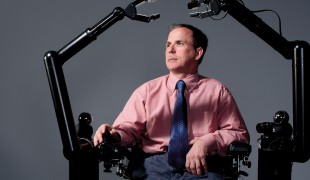
Paralyzed man designs innovative wheelchairs
CAREGIVING
MOVING IN A WHEELCHAIR: Moving using a wheelchair.
Grip
Rubgy
Basketball
Paralysis
Cervical spinal cord injury/Tetraplegia
Assistive Daily Life Device (to help ADL)
Assistive Technology access
Walking Aid (wheelchair/walker/crutches)
Restoring mobility
Replacing lost limbs
Promoting self-management
Promoting inclusivity and social integration
Recovering from Traumatic Injuries
Preventing (Vaccination, Protection, Falls, Research/Mapping)
Caregiving Support
Neurology
Orthopedics
Physical Medicine and Rehabilitation
United States
-
-
-
401
-
0
-
4972
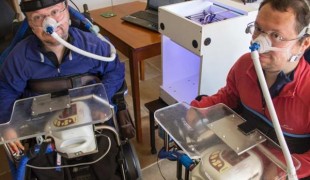
3D printing to cope with muscular dystrophy
MOVING IN A WHEELCHAIR: Moving using a wheelchair.
CAREGIVING
Duchenne Muscular Dystrophy
3d Printed
Assistive Daily Life Device (to help ADL)
Difficulty walking or moving
Muscle weakness
Limited range of motion
Muscle pain or stiffness
Loss of muscle coordination
Muscle cramps or spasms
Promoting self-management
Caregiving Support
Medical Genetics
Neurology
Orthopedics
Australia
-
 zh
zh