

- 4833
- 474
- 13
- 17
- 0
- Help Ukraine
About the solution
The team invented a fibreglass design that relies on the patient, who can’t speak or write, to communicate by only blinking an eye. They produced prototypes of this hand-held battery-powered tablet and gave them to other patients who were at Megumi’s hospital.
After feedback from these patients, some modifications were made.
The device can be used by people who struggle with the following: strokes, motor-loss, multiple sclerosis, amyotrophic lateral syndrome, motor neurone disease, cerebral palsy and speech impairment.
"While there are a number of other communication systems using blinking eye technology, this one is different because it's simple and does not need calibrating and can be used by those in a wheelchair. The tablet uses eye movement and blinking as the method to select letters, similar to a mobile phone keypad, which are displayed on the integral screen.
"Because of its construction, it's light and very easy to use and enables the patient a means of communication with their carer and requires minimal learning. It's an invention that is aimed at rapid and frequent use. Additional vocabulary can be loaded via a Bluetooth connection, which can incorporate a number of useful phrases”, Lyndon explained.
MegaBee™ is available in several languages and can be bought online.
Adapted from: https://bit.ly/2Kp9K6z
More info: http://www.megabee.net/
https://www.youtube.com/watch?v=Akgu9qyP1ew
This solution shall not include mention to the use of drugs, chemicals or biologicals (including food); invasive devices; offensive, commercial or inherently dangerous content. This solution was not medically validated. Proceed with caution! If you have any doubts, please consult with a health professional.
DISCLAIMER: This story was written by someone who is not the author of the solution, therefore please be advised that, although it was written with the utmost respect for the innovation and the innovator, there can be some incorrect statements. If you find any errors please contact the patient Innovation team via info@patient-innovation.com
-
-
1058
-
0
-
20622

Proloquo2Go – App to help people communicate
CAREGIVING
COMMUNICATION: Communicating, whether by speaking, listening, or other means
Social interaction
Paralysis
Autism
Cerebral Palsy
Brain Stroke
Brain Injury (Abscess, Brain Barrier Defect, Brain Contusion, Brain Hemorrhage, Brain Edema)
Assistive Daily Life Device (to help ADL)
Assistive Technology access
App (Including when connected with wearable)
Tremors
Muscle cramps or spasms
Difficulty coordinating movements
Muscle weakness
Difficulty speaking or understanding speech
Trouble with fine motor skills (e.g., writing, buttoning clothes)
Twitching or involuntary movements (myoclonus)
Acquired language impairment (Aphasia)
Promoting self-management
Managing Neurological Disorders
Building Supportive Community Relationships
Promoting inclusivity and social integration
Improving Speech and Communication
Caregiving Support
Clinical Pathology
Medical Genetics
Neurology
Pediatrics
Rheumatology
Netherlands
-
-
-
755
-
0
-
10649

Eye controlled communication devices
COMMUNICATION: Communicating, whether by speaking, listening, or other means
CAREGIVING
Cerebral Palsy
Assistive Daily Life Device (to help ADL)
Assistive Technology access
Recovering cognitive function
Promoting self-management
Managing Neurological Disorders
Promoting inclusivity and social integration
Improving Speech and Communication
Neurology
Ophthalmology
Pediatrics
United States
-
-
-
986
-
2
-
18679
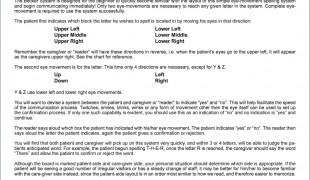
Vocal Eyes Becker Communication System
COMMUNICATION: Communicating, whether by speaking, listening, or other means
Social interaction
Amyotrophic Lateral Sclerosis
Multiple Sclerosis
Neuromuscular Disorders
Speech Disorder
Muscle Tone Abnormalities weakness
Assistive Daily Life Device (to help ADL)
Muscle cramps or spasms
Difficulty coordinating movements
Stiffness or rigidity (difficulty moving)
Paralysis of the legs and lower body
Muscle weakness
Difficulty speaking or understanding speech
Managing Neurological Disorders
Improving Speech and Communication
Neurology
United States
-
 en
en